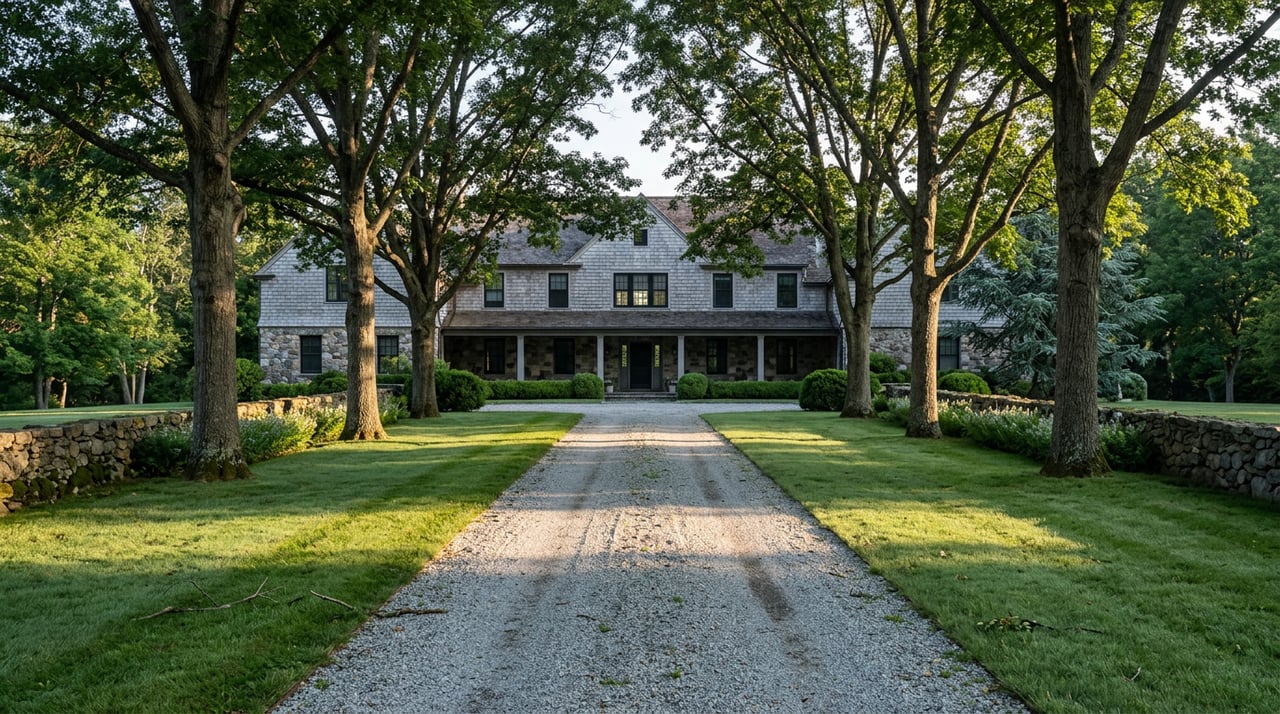
Drive any road in Old Westbury and the space between houses reads like geography, as if the land itself demanded this much room. It didn't. The two-acre minimum that defines nearly every listing in the village is a policy choice, written into Chapter 216 of the Village Code, and eight years ago the Village's own hired planners recommended changing it.
That recommendation never became law. But the fact that it was seriously studied, proposed, and then organized against by residents tells a buyer something the acreage figure alone does not: the low-density character priced into every Old Westbury listing is actively defended, not simply inherited.
The Numbers Behind the Acreage
Old Westbury splits most of its residential land into two zoning districts, and the difference between them comes down to exactly one acre. Under Article V of the Village Code, a "B" Residence District permits one family for every 43,560 square feet of lot area, or one acre. Under Article IV, a "BB" Residence District doubles that requirement to 87,120 square feet, or two acres, per family. Both figures come directly from the Village's own zoning ordinance, still in force.
The code doesn't stop at lot size. It regulates what an owner can do with the land, down to how many horses. Article IV permits one horse for every 20,000 square feet of lot area, with a hard cap of 30 horses no matter how large the property. It's a small provision, but it says something real: Old Westbury's zoning was never written just to cap density. It was written to preserve a specific way of living on the land, one with room for a paddock as much as a pool.
| Zoning District | Minimum Lot Size | Governs |
|---|---|---|
| B Residence (Article V) | 1 acre (43,560 sq ft) per family | Detached single-family homes, limited home-based professional offices |
| BB Residence (Article IV) | 2 acres (87,120 sq ft) per family | Detached single-family homes, accessory buildings, horse-keeping up to 30 animals |
How the Village Got Here
The two-acre standard isn't original to the village's 1926 zoning ordinance. It's a mid-century decision. According to the Village's own land use and zoning study, the Estate Era that defined Old Westbury's early character effectively ended after World War II, when an expanding Nassau County transportation network let New York City families look eastward for yards instead of apartments. In response, the Village rewrote its code in the early 1950s and folded nearly 90 percent of its land area into the two-acre BB district. That single rewrite, not natural scarcity, is why acreage still shapes what can be built in the BB district today.
The village that resulted is small by design. The Village's planning study puts its year-round population at roughly 4,700 people spread across 8.6 square miles, a density low enough that three gated communities coexist within the same eight-square-mile footprint as individual estates that range from the code-minimum two acres to well over a hundred.
A Village With No Storefronts
One consequence of that zoning history is easy to miss until you try to run an errand. There is no deli on the corner, no dry cleaner, no coffee shop inside the village line Residents drive north to Jericho, where the Milleridge Inn is located, or to the NYCB Theatre at Westbury for entertainment; for anything resembling a downtown, they head into the Village of Westbury itself.
For a buyer weighing Old Westbury against a village like Roslyn or Port Washington, this is the trade being made explicit. The privacy and acreage come with a genuine absence of walkable commerce, not an underdeveloped one waiting for a grocery store to arrive. That zoning question had already surfaced in the Village's 2018 study.
Where the Old Estates Actually Went
The original Gold Coast estates that the zoning code was written to protect didn't all survive as private single-family homes, and their different fates show the range of outcomes still possible under the current code. Old Westbury Gardens, the 200-acre former estate of John Shaffer Phipps, became a nonprofit museum and public garden, its Charles II-style Westbury House still standing as it was completed in 1906. SUNY Old Westbury and the New York Institute of Technology both sit on former estate acreage as well, with NYIT's campus built on what was once the Cornelius Vanderbilt Whitney estate. The Old Westbury Golf & Country Club occupies a different piece of that same Whitney property, and the WWII-era lookout tower built as the estate's original water tower still stands as the club's focal point. Meadow Brook Polo Club and the Westbury Equestrian Center keep the riding tradition active on land that the zoning code's horse provisions were written to accommodate.
None of that acreage was subdivided into smaller residential lots.
The Study That Tried to Change It
In 2018, the Village Board of Trustees commissioned its own land use and zoning study, and the reasoning behind it is worth sitting with. The study's stated purpose was addressing a lack of diversified housing options, specifically the absence of anywhere for empty-nesters to downsize without leaving the village entirely. The proposed amendments would have opened the door to higher-density, multi-family development on select parcels.
According to the Village of Old Westbury Civic Association, which organized in response, the proposed buildout would have increased the village's population by up to 20 percent and its number of occupied dwellings by 40 percent. Those aren't small adjustments to a village of 4,700 people. They represent a meaningfully different Old Westbury than the one currently on the market.
The study's recommendations never became code. The one-acre and two-acre minimums in Articles IV and V remain exactly as written. But the fact that the Village's own consultants recommended loosening them, and that residents organized in response while the acreage minimums remained intact is the part of this story that doesn't show up in a listing description.
What This Means for a Buyer or Seller
For a buyer comparing Old Westbury to other North Shore villages, the acreage isn't just a price signal. It's a zoning commitment that has proven durable under real pressure but isn't beyond revisiting. That distinction matters for anyone weighing a long-term hold against a village with a different zoning baseline, or anyone trying to understand why a comparable-sized home costs more per square foot in Old Westbury than in a neighboring village with smaller lot minimums.
For a seller, the same history is an asset. The acreage a buyer is paying for has already survived one serious attempt to change it, and the code that protects it is a matter of public record rather than a verbal assurance from a broker.
Frequently Asked Questions
Can a two-acre lot in Old Westbury be subdivided? The current code sets minimum lot-area requirements for both the B and BB districts, so the parcel's zoning matters.
Are all sections of Old Westbury zoned at two acres? No. Roughly 90 percent of village land was placed in the two-acre BB district during the early-1950s rewrite, but a B district requiring only one acre still exists in other sections, and some parcels within the village carry requirements above two acres.
Where do residents go for retail, dining, and entertainment? Residents rely on neighboring Jericho and the Village of Westbury for retail, dining, and entertainment.
If you're weighing what Old Westbury's acreage actually protects against what it costs to live inside a village with no commercial district of its own, that's a conversation worth having before you write an offer. Irene Rallis has spent nearly three decades reading North Shore zoning history the way most agents read comparables. Request your complimentary home valuation and get a straight answer on what your acreage is really worth, and why.
This article is general information, not legal, tax or financial advice. Consult a qualified professional about your situation.